
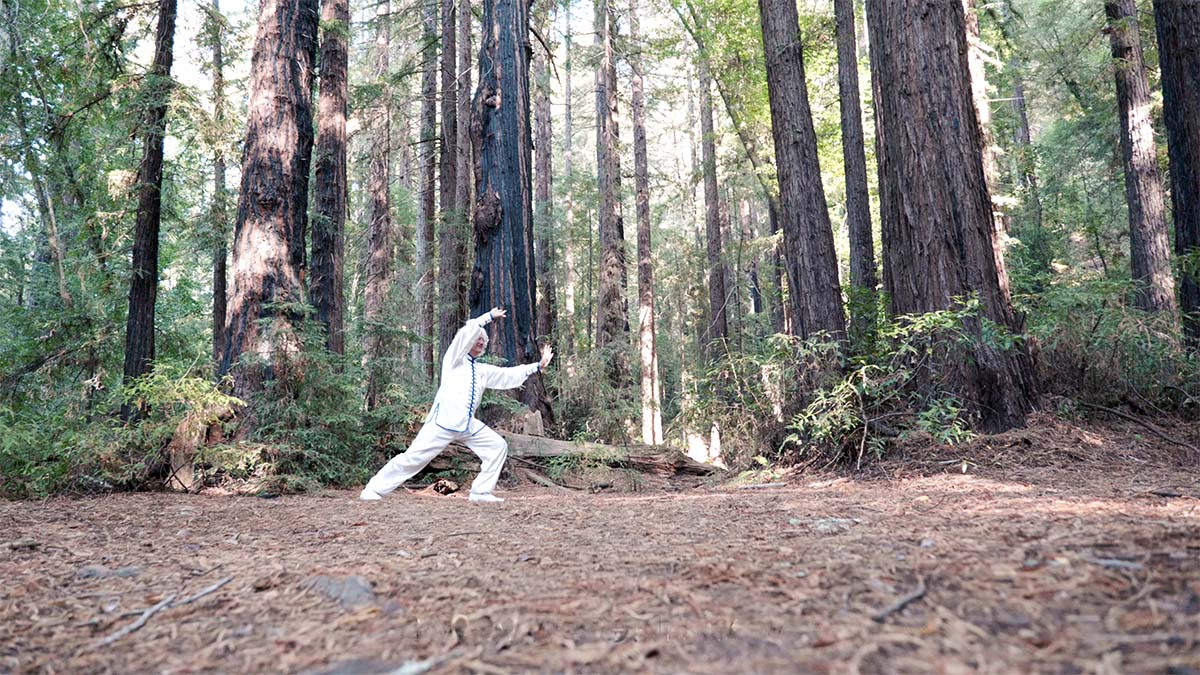
Yang Family Tradition
Tai Chi Chuan (Taijiquan) is one of the great classical martial arts of China, developed over generations as a complete system of movement, health cultivation, and self-defense.
Behind its slow, flowing movements lies a sophisticated body method designed to develop structure, coordination, internal connection, and efficient power.
At 10,000 Victories, the Tai Chi system we teach is rooted in the Yang Family tradition, preserved through direct lineage transmission.
The Yang style of Tai Chi traces its origins to Yang Luchan, often called “Yang the Invincible,” who brought the art into wider public teaching.
Over generations, the Yang family refined and transmitted the art, preserving both its martial function and its internal training methods.
Today, many versions of Tai Chi have been simplified or modified for accessibility.
While these versions can still provide health benefits, they often lose the structural precision and martial intent that define the original art.
The traditional system preserves these deeper qualities.
Grandmaster Wong Jackman — A Complete Transmission
The Tai Chi taught at 10,000 Victories comes through Grandmaster Wong Jackman, one of the early pioneers of Chinese martial arts in the United States.
At a time when Tai Chi and Kung Fu were largely unknown in America, Wong Jackman taught a complete traditional system — not a simplified version.
His Tai Chi preserved:
- The full Yang Family Long Form
- Practical body mechanics aligned with martial application
- Partner training methods such as Push Hands and Da Lu
- Classical weapons training, including Tai Chi sword
Unlike many modern interpretations, his form retained the depth, structure, and functional mechanics necessary for both internal development and real application.
He taught openly to students of all backgrounds, helping bring authentic Chinese martial arts to a broader audience.

Depth of Training — Beyond a Single Source
While rooted in the Wong Jackman lineage, Sifu Scott Jensen’s study extends across several major Tai Chi traditions.
He has trained with Grandmaster Yang Zhenduo, the head of the Yang Family Tai Chi lineage, gaining insight into the classical long form directly from the family tradition.
He has also studied with Grandmaster Chen Xiaowang, one of the leading representatives of Chen Style Tai Chi, where he learned foundational internal mechanics such as silk-reeling (Chan Si Jin), body sequencing, and power generation.
In addition, his training includes exposure to other traditional systems, including Chen Man-Ching style, Wu style and Chen Pan Ling’s Tai Chi curriculum.
This breadth of study provides a wider perspective on Tai Chi’s internal principles — while remaining grounded in a coherent, traditional system.
Preserving the Complete Art
Historically, Tai Chi was not a single exercise or short routine, but a complete training system.
A traditional curriculum included:
- Long form training for structure and coordination
- Standing and foundational practices to build internal connection
- Partner exercises to develop sensitivity and timing
- Martial applications to understand function
- Weapons training to refine precision and control
This integrated approach ensured that the art developed the body, mind, and internal qualities together.
Today, it is increasingly rare to encounter this level of completeness.
At 10,000 Victories, this traditional structure is preserved and taught progressively, allowing students to experience the art as a living system rather than a collection of isolated techniques.
A Living Lineage
Tai Chi is not only something to study — it is something to experience and embody over time.
Through consistent practice, the principles passed down through generations become tangible:
movement becomes more efficient, balance becomes more stable, and the mind becomes calmer and more focused.
This is the value of lineage — not just history, but direct transmission through practice.
Begin Your Training
To explore Tai Chi in practice and take the next step:
→ Tai Chi Classes in San Rafael, California
→ Tai Chi Training Methods and Complete System
→ Learn More: What is Tai Chi?
Looking for Remote Study?