
Chicken Stock for Kidney Yin: A Taiwanese Kitchen Remedy for Recovery and Healthy Aging
In Taiwan, food and medicine have never been entirely separate. Growing up, I absorbed this without thinking much about it — it was just how people talked about food. This is good for your liver. That one clears heat. Eat this when you’re tired; avoid that when you’re sick. These weren’t clinical conversations. They were the kind of thing exchanged over a meal, or when someone noticed you looked pale or run-down.
The kitchen was a form of preventive medicine. And chicken stock was one of its most reliable tools.
What Kidney Yin Actually Means
In Traditional Chinese Medicine, the Kidney system governs your deepest reserves — long-term energy, hormonal balance, recovery capacity, and the aging process itself. Kidney Yin is the cooling, moistening dimension of that system. Think of it as the body’s reservoir: when it’s full, you feel hydrated, resilient, and clear. When it’s depleted — through illness, overwork, age, or chronic stress — the body starts to show it. Practices like Qigong are traditionally used alongside diet to support this internal regulation.
The signs are often subtle at first: dry skin or eyes, hair that thins or loses luster, energy that fades in the afternoon, a general sense of running low that sleep alone doesn’t fix. These aren’t emergencies, but they are signals. And in TCM, they’re addressed through consistent, gentle nourishment — not aggressive intervention.
This is where chicken stock enters the picture.
Why Chicken Stock
Chicken has been used in Chinese medicine for centuries to support two systems that matter most for recovery: the Spleen (which governs digestion and absorption) and the Kidney (which governs deep reserves and long-term vitality). When you’re depleted — whether from illness, aging, or simply a long stretch of hard living — your digestion is often the first thing to weaken. And if digestion is weak, even the best food doesn’t fully reach you.
A slow, well-made broth changes this. It’s already broken down. It’s warm and easy to receive. It delivers minerals, collagen, and nourishment in a form the body can absorb even when it’s struggling.
In many cultures, chicken soup is instinctively used during recovery. TCM explains why it works — and adds a layer of intentionality to the ingredients.
How to Make It
This is the version I make at home. It’s straightforward, but each ingredient is there for a reason.
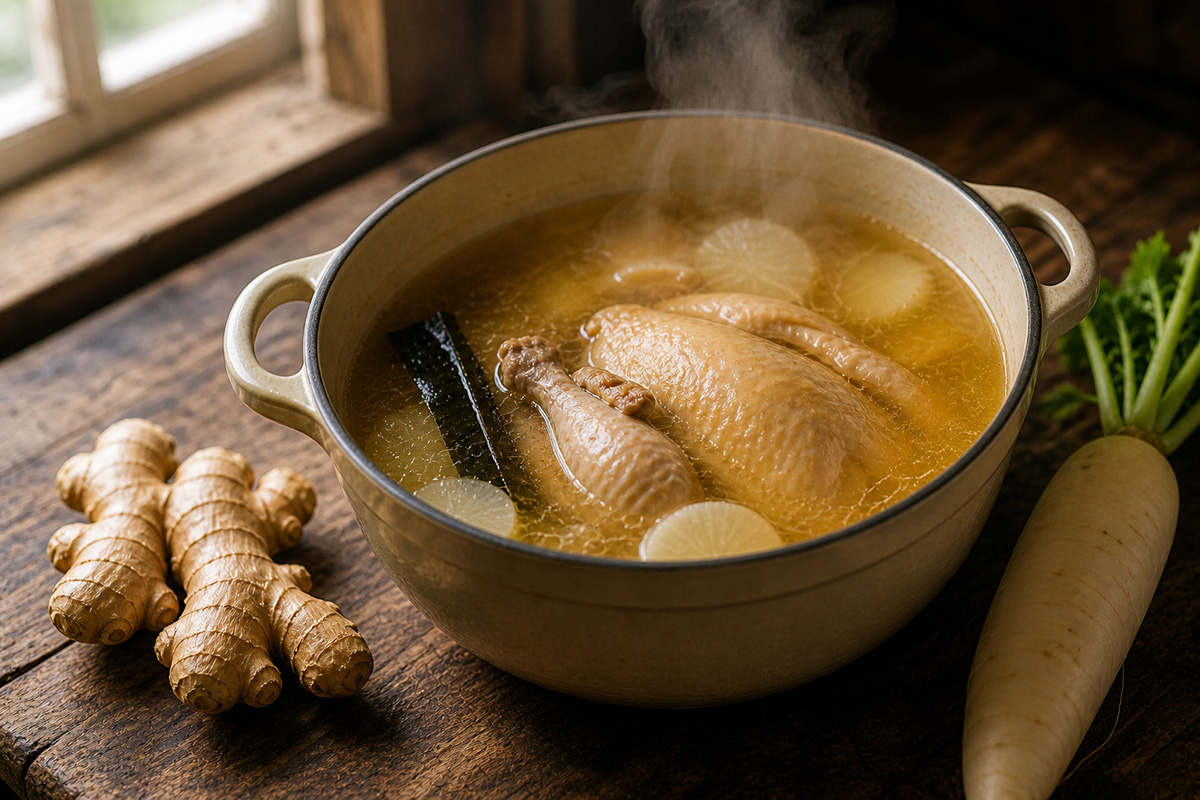
Start with one organic whole chicken. Trim the excess fat — you want a clean, nourishing broth, not a rich or heavy one. Before you start the actual stock, blanch the chicken: place it in boiling water for 2 or 3 minutes, then discard that water. This removes impurities and produces a cleaner, lighter result. It’s a small step that makes a real difference.
Place the blanched chicken in a clean pot with cold water and bring it to a boil. Then add your ingredients:
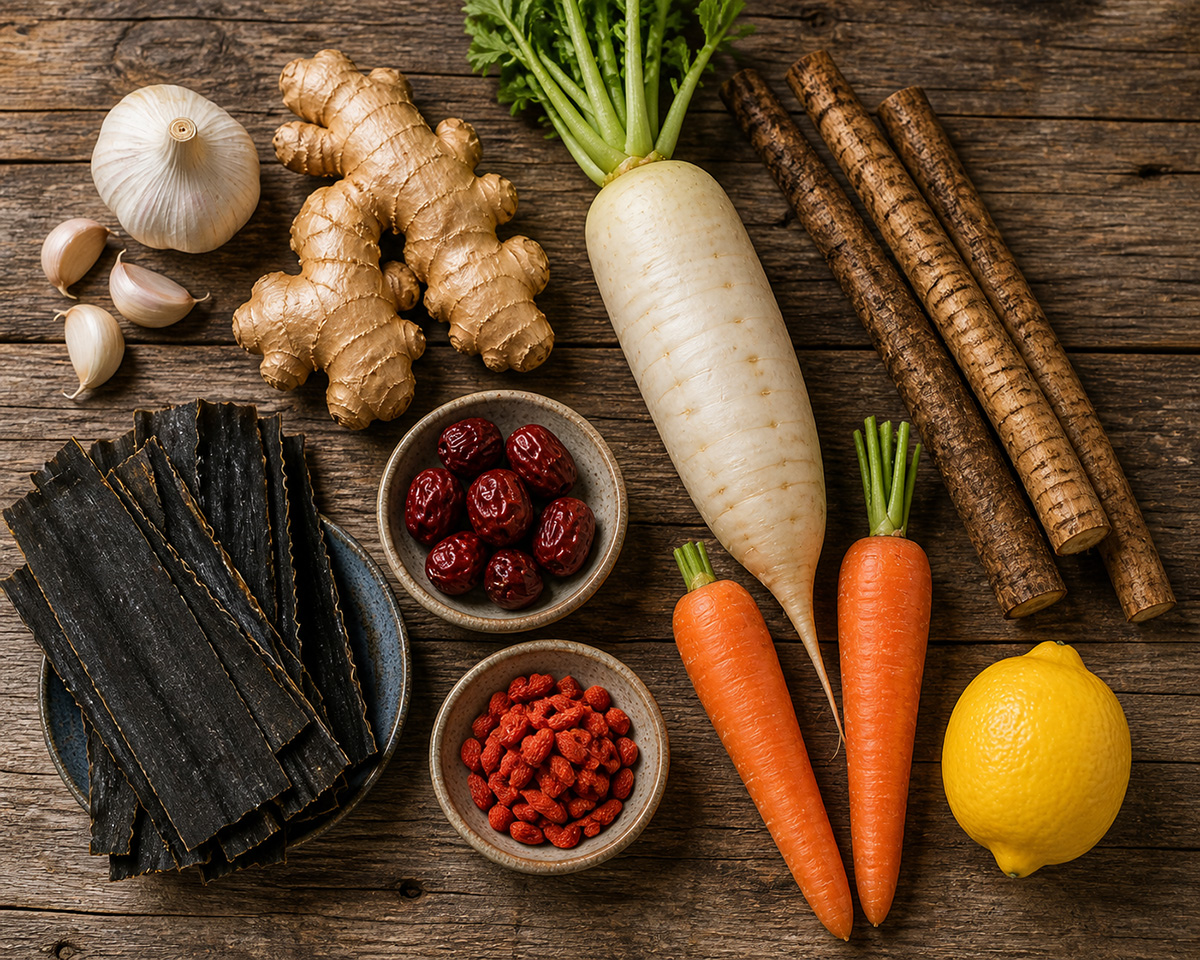
- a whole onion
- a whole head of garlic (the foundation of warmth and immune support)
- fresh ginger (activates and supports digestive function)
- carrots (support Spleen Qi and add natural sweetness)
- daikon (helps move stagnation and lighten the broth)
- burdock root (supports circulation and the body’s clearance pathways)
- small piece of dried kelp (mineral-rich and specifically supportive of the Kidney system)
- a whole lemon (balances the richness)
Reduce to a low simmer and cook for 40 to 60 minutes. I like to pull the chicken out about halfway through and carve off the breast meat before it dries out — the legs and carcass can go back in to finish. Use the meat you’ve set aside for other simple dishes of your choice. When the broth is done, strain it, let it cool, and store it. I like to freeze some in small portions in pyrex glass containers if I am not able to finish the broth in 3 days.
How to Use It
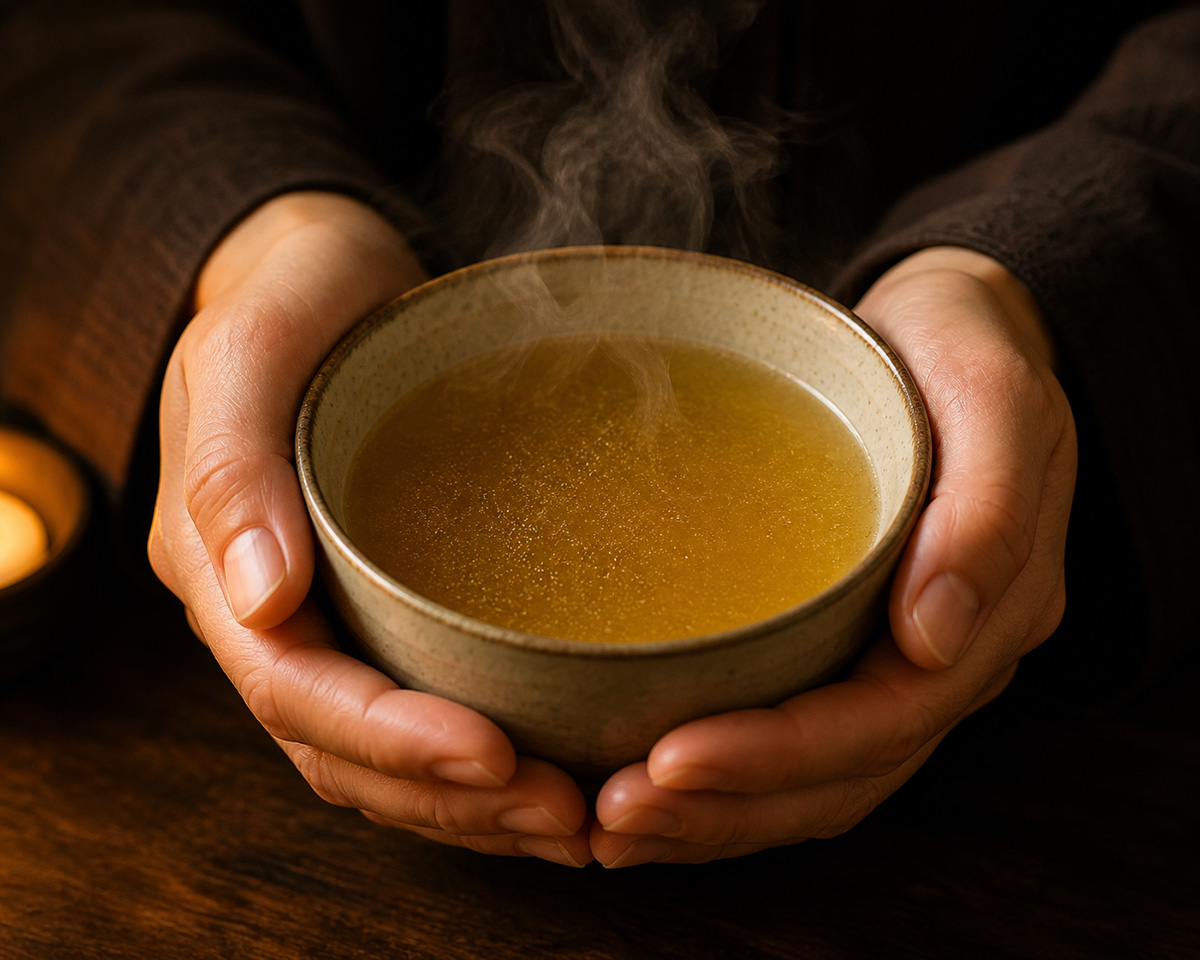
The simplest thing is to sip it warm with a little salt. This is particularly good first thing in the morning or in the late afternoon when energy tends to dip.
The more powerful application is congee — rice cooked slowly in the broth until it becomes a soft, deeply nourishing porridge. Congee has been used in Chinese medicine for recovery from illness for a very long time, and for good reason. It’s almost effortlessly digestible, which means the body can absorb what it needs without expending the energy it’s trying to rebuild. A bowl of congee made with this stock, eaten warm and without distraction, is a form of care that the body recognizes.
You can also use the stock as a base for soups, or to cook grains, or anywhere you’d otherwise use plain water. Every time you do, you’re adding nourishment without effort.
Optional Additions to Your Dish
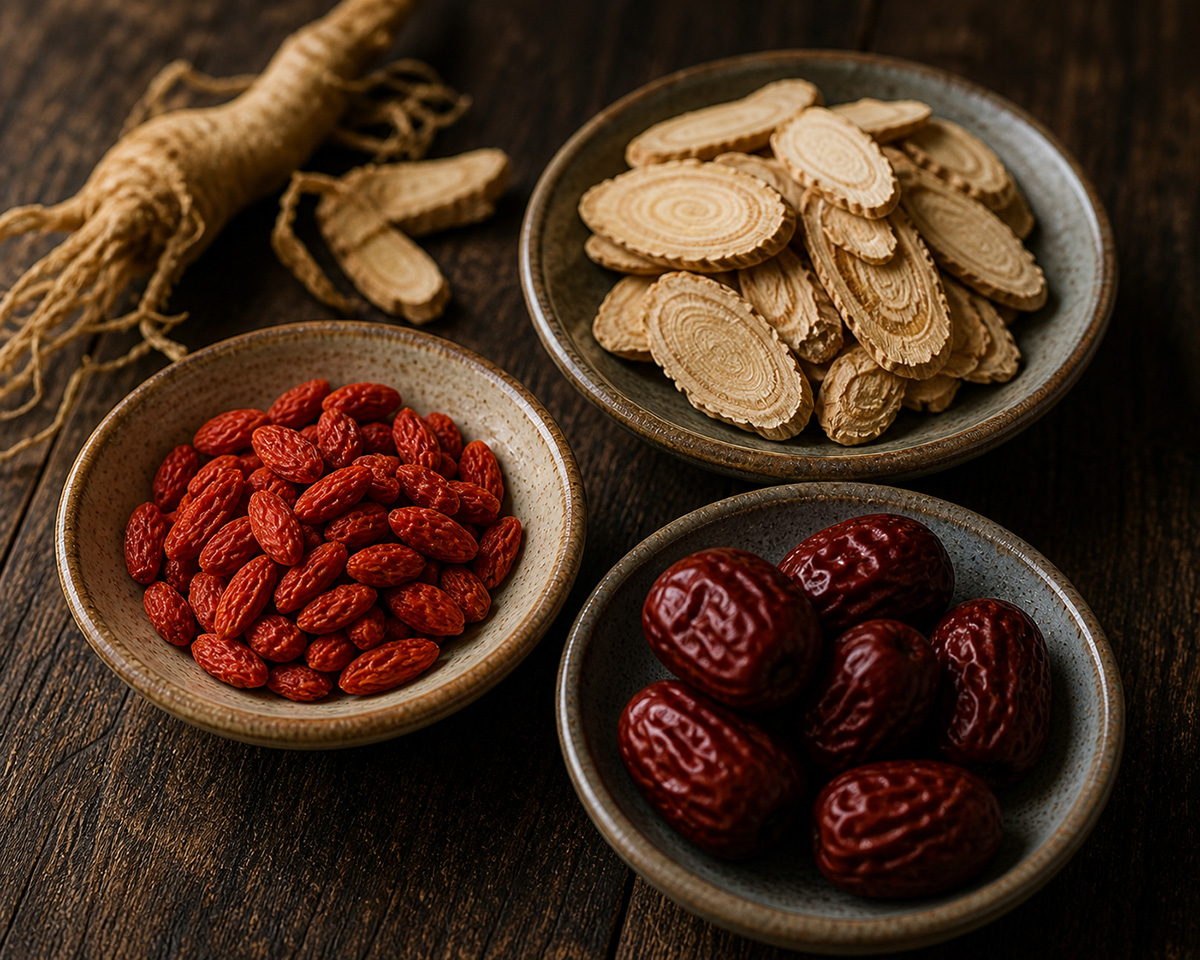
If you want to gently enhance the formula, three additions are worth knowing. American ginseng (西洋參, Xi Yang Shen) provides mild, cooling energy support — unlike Korean red ginseng, it doesn’t create heat, which makes it appropriate for Yin deficiency. Goji berries (枸杞, Gou Qi Zi) are one of the most well-known Kidney Yin tonics in the Chinese tradition — they nourish both fluids and blood and are mild enough to use regularly. Jujube dates (紅棗, Hong Zao) support the Spleen and calm the nervous system; they add a gentle sweetness and are commonly found in Taiwanese kitchens.
None of these are required. But if you find yourself making this stock regularly, they’re a natural next step.
The Principle Underneath the Recipe
What I want to offer here isn’t just a recipe. It’s a way of thinking about food that I grew up with and have come to value more with age.
In Taiwan, the conversation about food is constantly running in the background. Someone’s child is pale and the grandmother recommends longan and red dates. Someone is recovering from surgery and the family begins planning the right congee. These aren’t medical interventions — they’re expressions of care, rooted in a living tradition that treats the body as something to be tended steadily over time.
The goal, in that tradition, is never dramatic. It’s accumulation. Consistent, gentle nourishment, day after day, builds something that a week of aggressive supplementation cannot.
Nourishment Moves — It Doesn’t Just Sit
Food builds the reservoir. Practice is what keeps it circulating.
In the classical Chinese tradition, diet and movement were never treated as separate concerns. TCM physicians prescribed both — specific foods to replenish what was depleted, and specific exercises to ensure that nourishment reached where it needed to go. A body that eats well but moves poorly tends toward stagnation. A body that trains hard but doesn’t replenish tends toward depletion. The two work together, or they work against each other.
This is one of the reasons Qigong and Tai Chi have such a strong tradition of supporting recovery and healthy aging. They’re not vigorous in the way that depletes — they’re precisely calibrated to move Qi and Blood through the body gently and thoroughly, supporting the same systems this stock is designed to nourish. Regular Qigong practice supports Kidney function, aids the Spleen’s role in digestion and absorption, and keeps the circulatory and lymphatic systems moving without taxing reserves that may already be low.
Kung Fu — Northern Shaolin, Xingyi Quan, Bagua Zhang — works at a different register. These are arts of building and refining, not just maintenance. Over time, consistent practice restructures how the body generates and stores energy. But even here, the principle holds: you cannot train your way out of chronic depletion. The food has to be there too.
Eat well. Practice consistently. These are not two separate commitments — they’re one.
If you’re local to San Rafael, in-person Tai Chi, Qigong, and Kung Fu classes are a natural complement to everything described here. If you’re training from home, the 10,000 Victories online platform includes dedicated Qigong sequences specifically designed for energy cultivation and recovery support.